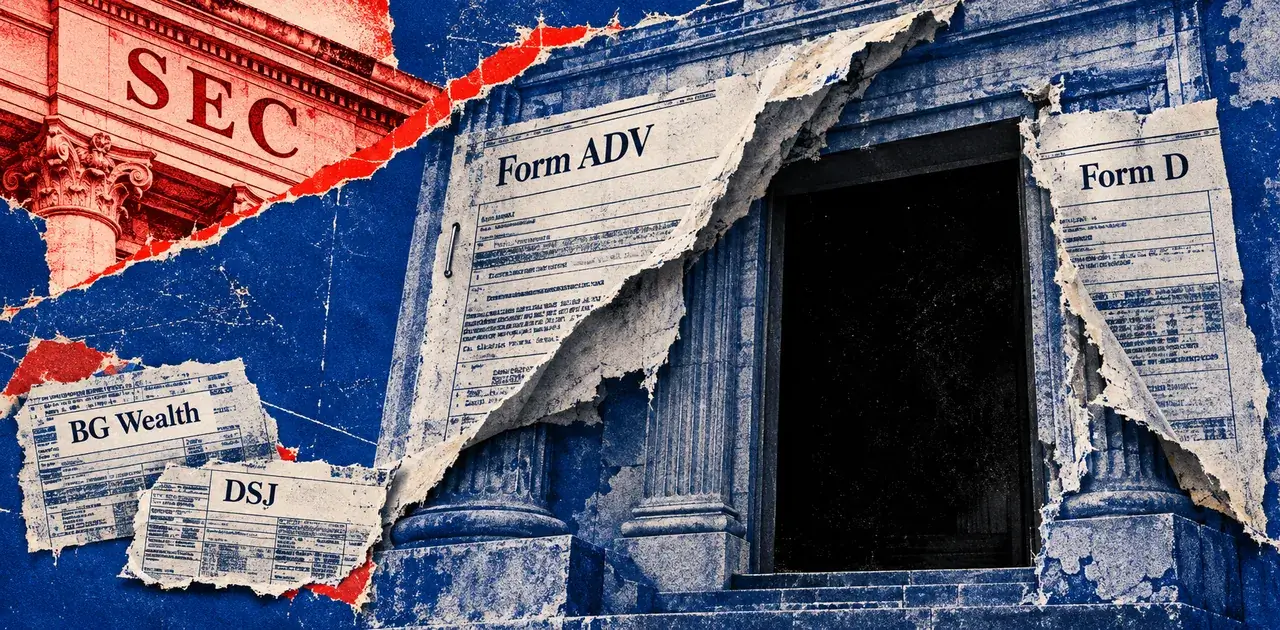
The SEC's public disclosure systems, built to inform investors, were allegedly turned into marketing props in a crypto scheme that the agency says drew more than $130 million from tens of thousands of people. On October 29, 2026, the Commission sued BG Wealth Sharing and DSJ Exchange in the Northern District of California and removed the filings the two firms had leaned on as proof of legitimacy. For institutional readers, the case is less about one scheme than about a trust assumption: that a document sitting on EDGAR or the Investment Adviser Public Disclosure site signals regulatory approval. It does not.
According to the SEC's complaint, the operation ran from at least October 2025 to June 2026. Promoters advertised monthly returns of at least 60% and told investors they could double their money within 40 days with no risk. BG Wealth styled itself the world's largest hedge fund and an SEC-licensed investment adviser, while DSJ Exchange presented a secure trading platform that supposedly executed profitable trades. The agency alleges the trading was fictitious and that most deposits were diverted rather than invested. These are allegations, not findings, and neither defendant has been adjudicated liable.
The mechanics are what make the case instructive. BG Wealth filed a Form ADV claiming status as an exempt reporting adviser. DSJ Exchange filed a Form D announcing a purported $100 million securities offering. Both documents were publicly searchable, and promoters allegedly pointed prospective investors to them as evidence that the SEC had vetted the business. The firms also reportedly circulated fabricated registration certificates bearing the SEC's seal and identifiers tied to those real filings.
Here is the gap that was exploited. Form ADV for an exempt reporting adviser and Form D for an exempt offering are notice filings. They tell the market that an entity exists and claims an exemption; they do not signal that anyone at the Commission reviewed the business, tested its claims, or approved it. Low filing friction is a deliberate feature of the disclosure regime because it keeps capital formation cheap for legitimate issuers. The same feature gives bad actors a government-hosted URL to show to retail victims.
The on-chain trail gave investigators unusually clean numbers. The SEC's tracing, as reported by CryptoSlate, points to the following:
Filing a form is not the same as being approved, and the distance between those two ideas is where this alleged fraud lived.
The Commission took the BG Wealth Form ADV and the DSJ Exchange Form D off its public websites. In court, it is seeking permanent injunctions, financial penalties, and repayment of allegedly unlawful gains with interest. It also wants BG Wealth barred from making future Form ADV filings as an exempt reporting adviser. Whether investors recover meaningful sums is unresolved, and with most funds allegedly misappropriated, recovery odds look modest.
For allocators, custodians, banks and compliance teams, the practical lesson is procedural. Treat the existence of a filing as zero evidence of legitimacy. Distinguish clearly between registered and exempt status, confirm any claimed license through the registration databases rather than through a document the counterparty supplies, and verify seals or certificates independently. Blockchain analytics also deserve a place in onboarding for crypto-adjacent counterparties, since the scale of address-level inflows here is exactly the kind of signal that is visible long before a regulator sues.
There is also a policy question the case raises without answering. If notice filings keep being weaponized, the Commission may face pressure to add clearer disclaimers, labels or verification features to those records, though any such step would need to avoid raising costs for compliant small issuers. Until then, the burden of skepticism sits with the reader of the filing. The bottom line for research desks: a government domain proves where a document is hosted, not whether the business behind it deserves capital.
Keywords: SEC enforcement, crypto fraud, Form ADV, Form D, EDGAR, BG Wealth Sharing, DSJ Exchange, investor protection
Source: CryptoSlate