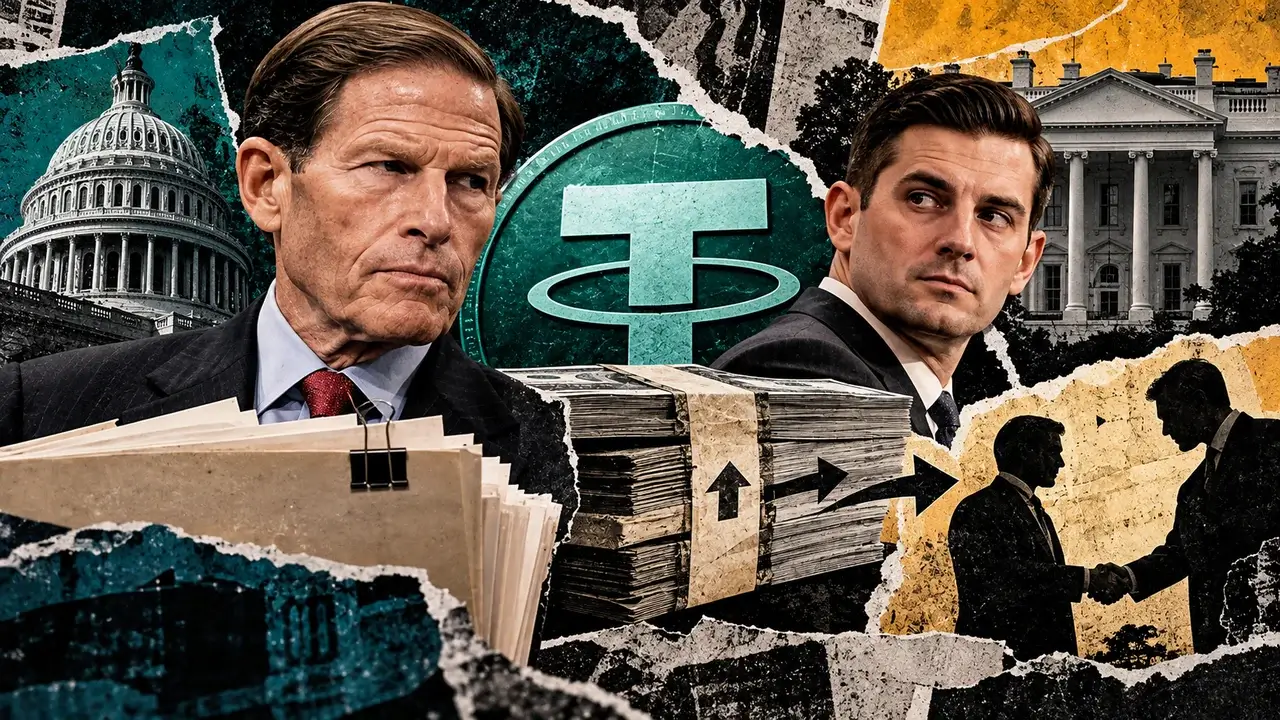
A U.S. Senate investigation is casting a sharp spotlight on Tether's financial relationships with Washington insiders, raising significant concerns about the integrity of the regulatory process that produced the GENIUS Act — the landmark stablecoin legislation enacted in July 2025.
Senator Richard Blumenthal has formally demanded transaction records and communications related to Tether's reported payments of over $6 million to Nxum, a consulting firm co-owned by Bo Hines. Hines served as the executive director of the White House's Digital Asset Advisory Council under the Trump administration while simultaneously retaining a one-third ownership stake in Nxum, which was receiving $415,000 per month from Tether beginning in May 2025.
From an institutional investor perspective, this investigation strikes at a fundamental question: were the regulatory frameworks that now govern stablecoin issuers — including extended compliance timelines for foreign issuers like Tether — shaped by compensated advocacy rather than neutral policy deliberation? Blumenthal's letter specifically alleges that Hines advocated for GENIUS Act provisions benefiting Tether's offshore USDT operations, a claim that, if substantiated, could trigger SEC and DOJ scrutiny under federal ethics and anticorruption statutes.
The payment routing structure adds another dimension of concern. Funds initially flowed through Notorious, a marketing firm, before reaching Nxum — a structure that institutional compliance officers would immediately flag as a potential money-flow obfuscation pattern. After Hines departed government service in August 2025, Tether began contracting with Nxum directly, and Hines subsequently became CEO of Tether's U.S. stablecoin division.
For U.S. institutional participants navigating the stablecoin landscape, this investigation carries operational implications. Tether's domestic expansion — anchored by USA₮ and custodied through Anchorage Digital Bank — is now politically exposed. Any adverse finding could delay or reshape the regulatory certainty that institutional players require before committing capital to dollar-pegged instruments. The November 6 document deadline set by Blumenthal suggests this story will escalate through Q4 2026.
Keywords: Tether, GENIUS Act, stablecoin regulation, SEC enforcement, crypto lobbying
Source: CryptoSlate