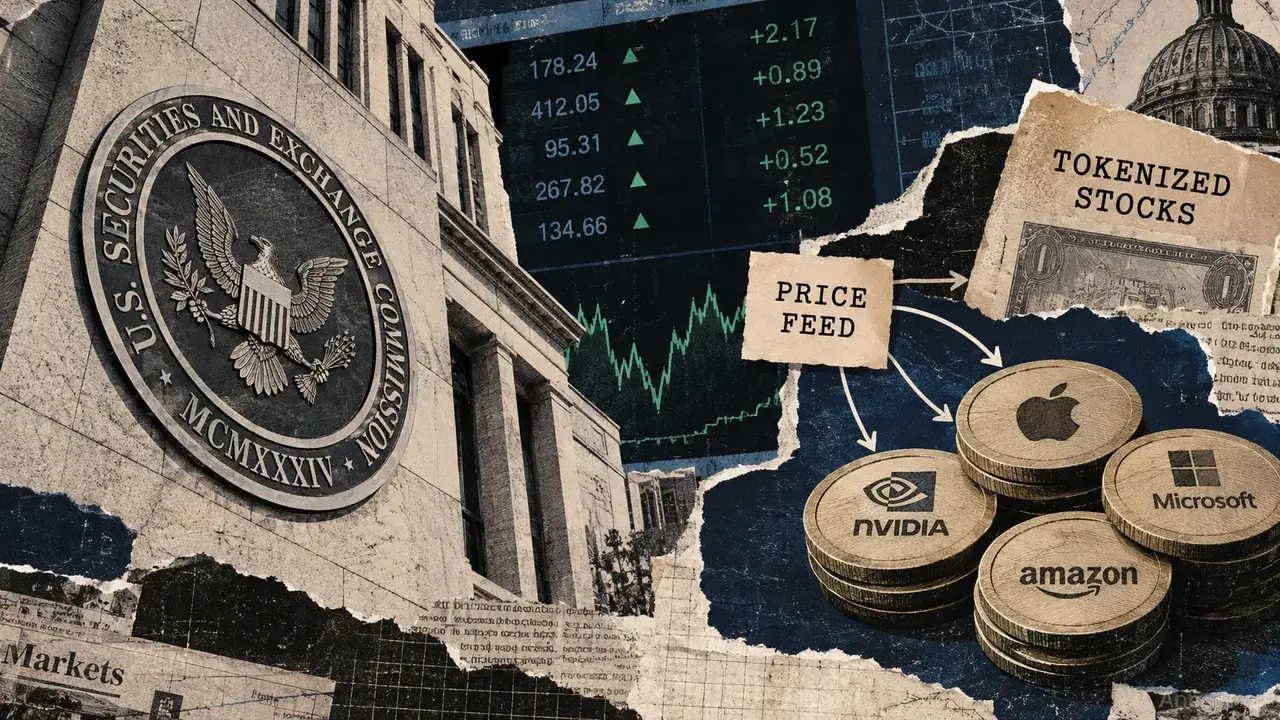
The SEC's September 2026 exemption for tokenized stocks grants trading venues conditional relief from exchange registration requirements — but it does not extend the same Regulation NMS trading protections to investors. Understanding the gap between what tokenized shares represent and how orders are actually priced and executed is now essential due diligence for any investor entering this market.
The order, issued September 17, allows permissioned automated market maker (AMM) pools to offer tokenized National Market System (NMS) securities outside the traditional exchange and alternative trading system framework. That relief, however, explicitly carves out key protections under Rule 611 — the trade-through rule that prevents executions at prices worse than publicly available quotations on other venues. The regulatory exemption and investor protections are structurally separate, and investors who assume the former guarantees the latter face real risk.
The September exemption applies only to a narrow category of eligible tokenized stocks. Third-party synthetic instruments, including tokenized linked securities and security-based swaps, are excluded, as are rights and warrants. A venue must verify that tokenized shares carry the same rights and privileges as traditional stock of an equivalent class — including ownership interest, dividend entitlement, voting rights, and a claim on residual assets upon liquidation.
Confirming those rights answers what an investor owns. It does not answer the question of how and at what price they buy or sell it. That distinction sits at the core of the exemption's regulatory design.
AMM pools set execution prices through pool asset ratios — the relative quantities of assets committed to the pool — rather than through traditional order books. External price data may serve distinct and separate functions: displaying stock valuations, detecting trading halts on underlying markets, converting stablecoin-denominated transactions to dollars for regulatory reporting, and in some configurations, setting reference-price bands.
The SEC order requires venues to disclose their oracle usage, identify data providers and sources, describe known manipulation risks, and outline any reference-price controls. What it does not mandate is a single approved provider, a minimum number of independent data contributors, a standard aggregation methodology, or a uniform policy for handling stale or unavailable prices.
Douro Labs, a contributor to the Pyth Network, filed a comment with SEC staff on October 9 proposing a framework to evaluate price-feed quality. Their criteria highlight:
Venue filings already illustrate the complexity in practice. OKXICE's October 4 notice describes AMM execution prices set entirely by pool ratios, with external data used only for valuation display, halt detection, and dollar conversion. TSV LLC's September 23 notice discloses that a production data provider had not yet been selected at the time of filing. Investors reading venue notices should identify precisely what role external data plays — execution pricing, display, reporting conversion, or risk controls — before drawing conclusions about execution quality.
FINRA-member brokers handling covered customer transactions in tokenized stocks remain subject to Rule 5310's best-execution obligations. These obligations require reasonable diligence to find the best available market and obtain the most favorable price possible under prevailing conditions.
A member cannot transfer that duty to another person. Automated, non-discretionary order routers and internalizers must conduct execution-quality reviews at least quarterly, by security and order type, and compare current arrangements with competing markets. Material execution-quality differences require changes to routing or a documented justification for retaining it.
The best-execution standard is broader than confirming that a pool's execution price matched a single external reference. It accounts for transaction size, speed, the likelihood of order fulfillment, costs, and customer-specific requirements. FINRA Regulatory Notice 26-15 has sought comments on modernizing this guidance under the existing principles-based framework, further signaling that the regulatory treatment of tokenized-stock execution is still evolving.
For US crypto investors and researchers, the practical compliance and risk checklist for tokenized stocks now has two distinct layers:
The SEC's September order represents a measured opening of tokenized equity markets, not a wholesale deregulation. Investors who treat the exemption as a signal that standard market-structure protections apply risk misjudging the actual regulatory perimeter. The venue notice, the broker's execution review, and the price-feed design are the real due-diligence targets — not the exemption itself.
Keywords: SEC, tokenized stocks, crypto regulation, Regulation NMS, AMM, FINRA, price feed, oracle, best execution, crypto compliance
Source: CryptoSlate