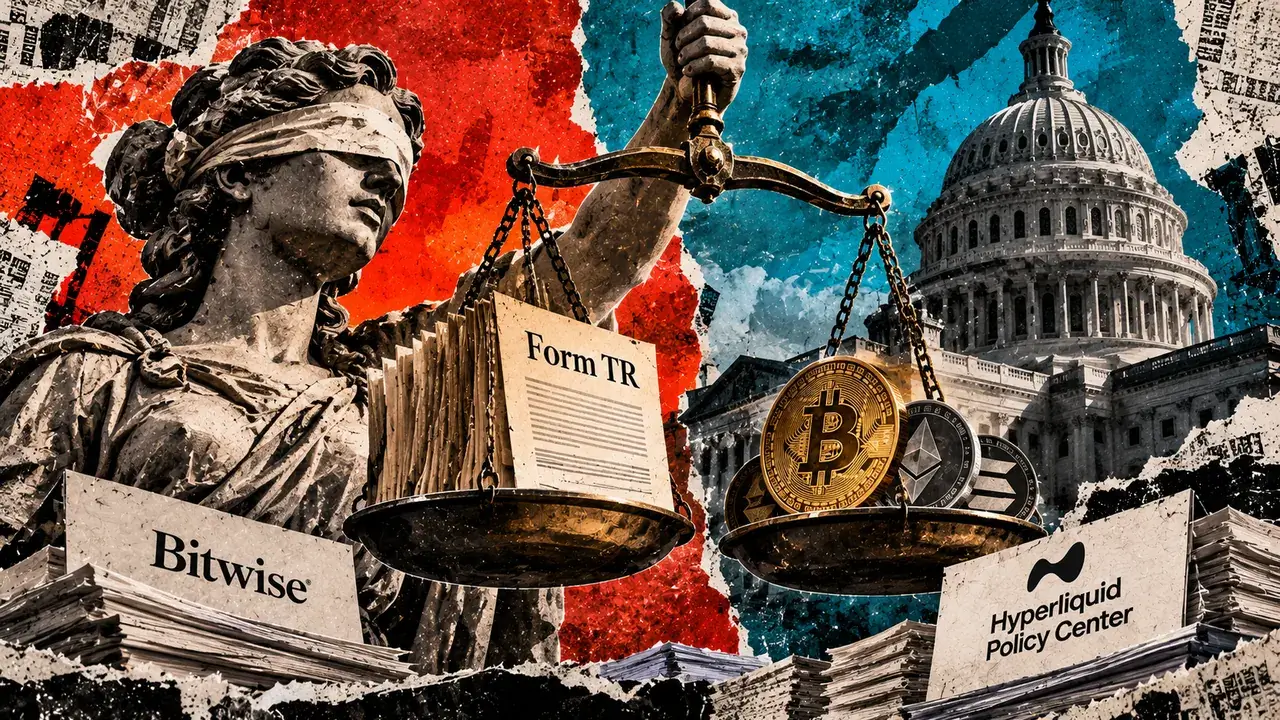
The Securities and Exchange Commission's proposed Regulation Crypto Assets, published August 21, represents the agency's most significant structural attempt to create a purpose-built disclosure framework for digital asset capital formation. The proposal, now past its October 20 comment deadline, permits qualifying projects to raise up to $5 million over four years or $75 million annually without registering as investment-contract offerings — provided issuers comply with disclosure requirements and remain subject to federal antifraud provisions.
The proposal's most consequential provision for institutional market participants is the safe harbor mechanism. Once a project completes — or permanently abandons — its essential managerial work and files a transition report with the SEC, the underlying crypto asset can potentially cease being classified as a security. This decoupling pathway has significant implications for ETF sponsors and fund managers who currently face "substantial uncertainty" when assessing whether a token held in an exchange-traded product or private fund still carries securities-law exposure. Bitwise Asset Management's comment letter articulated this tension directly, noting that clarity on which cryptocurrencies can be held in ETPs and private funds is essential for the sector to scale responsibly.
The opposition is multidimensional and legally sophisticated. Nasdaq endorsed the framework but drew a firm boundary: tokenized stocks, bonds, and ETF shares must be explicitly excluded, or crypto platforms would gain competitive regulatory arbitrage advantages over traditional exchanges. This concern reflects a broader structural worry that a permissive Regulation Crypto Assets could hollow out established market structure protections.
From the banking sector, the Independent Community Bankers of America flagged existential risk. Their modeling projects that stablecoin incentives could redirect as much as $1.3 trillion from community bank deposits — a figure that, if accurate, would represent a historic disintermediation of traditional banking infrastructure. For institutional investors, this macro dynamic is relevant: accelerated stablecoin adoption driven by SEC-endorsed crypto capital formation could reshape the liability side of the U.S. banking system.
The legal threat is credible. Former SEC enforcement official John Reed Stark and researcher Lee Reiners have publicly demanded withdrawal, arguing the agency lacks statutory authority for the proposed exemptions and warning that any final rule faces immediate legal challenge. For institutional compliance teams, this means Regulation Crypto Assets is unlikely to provide durable safe-harbor certainty without parallel Congressional action — a planning reality that sophisticated market participants must price into their regulatory roadmaps.
Keywords: SEC, crypto regulation, Bitcoin ETF, token disclosure, institutional crypto
Source: CryptoSlate