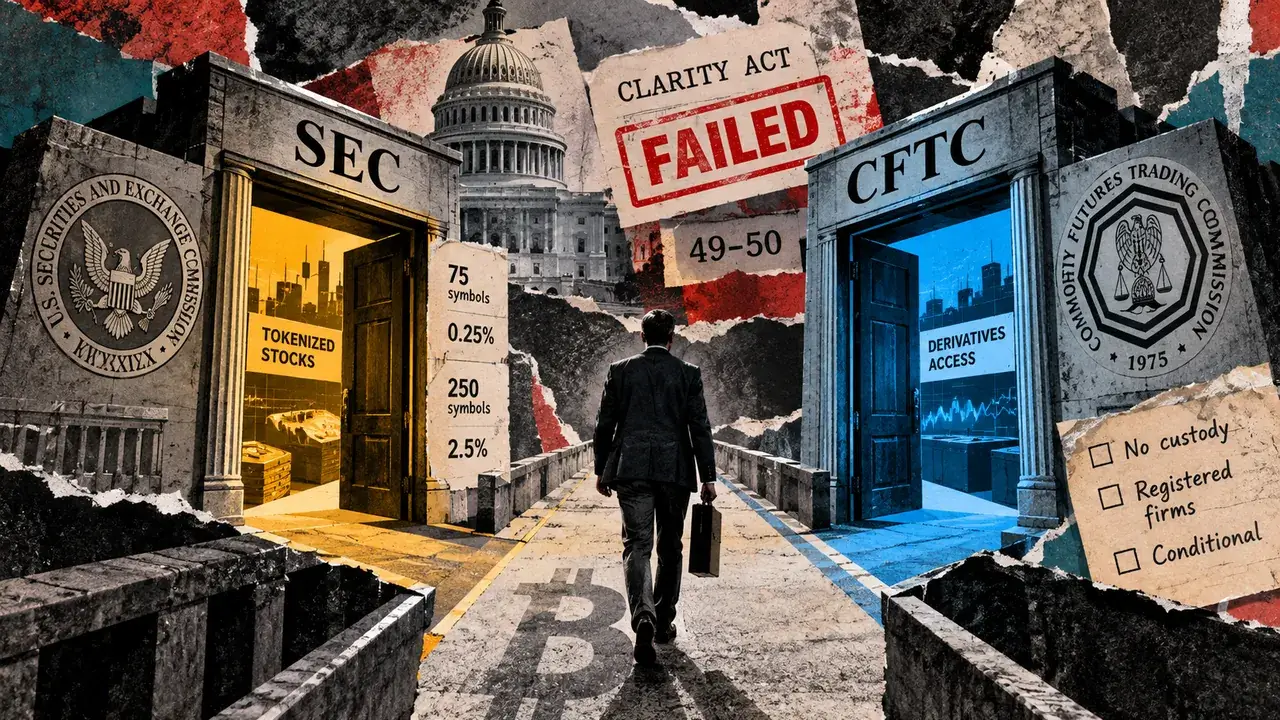
Two days after the Senate killed the CLARITY Act in a 49-50 procedural vote, the SEC and CFTC moved anyway. On September 17, 2026, both agencies published frameworks that expand crypto-linked market access under existing statutory authority — no new legislation required. The result is real, usable infrastructure for tokenized US stocks and regulated crypto derivatives. It also comes with caps, conditionality, and no guarantee of permanence.
For US investors and market participants watching Capitol Hill stall out, this is the most significant regulatory development of 2026. But understanding what these frameworks actually allow — and what they explicitly do not — is essential before treating them as a green light.
SEC Chairman Paul Atkins framed the Commission's action as a "bridge toward durable rulemaking" — an acknowledgment that this is not permanent market structure, but a structured pilot. The agency created a new category called the Tokenized Securities Venue (TSV), allowing qualifying platforms to match buyers and sellers via permissioned automated market maker pools without triggering full Exchange Act compliance obligations.
The exemption runs five years, expiring September 17, 2031, unless modified earlier. Volume ceilings are strict by design: Tier 1 stocks are limited to 75 symbols and 0.25% of prior-month average daily share volume per security. Tier 2 allows 250 symbols and up to 2.5%. Tokenized stocks must carry the same dividend and voting rights as traditional shares. Synthetic exposure tokens, warrants, and primary offerings are excluded entirely.
Perhaps the most important operational constraint is the issuer objection mechanism. Before a TSV can trade a third-party tokenized stock, it must notify the issuer and wait 30 calendar days. If the issuer objects within that window, trading is blocked on that venue. Issuers retain direct control authority over whether their equity appears in tokenized form.
Despite the permissioned nature, this framework gives firms something concrete to build toward. Rather than waiting for legislation that may not arrive before the midterms, platforms can now design to specific SEC-defined parameters.
The CFTC's contribution, Letter 26-25 from the Market Participants Division, generalizes relief that was previously granted exclusively to Phantom wallet in March 2026. The new position applies broadly to any qualifying passive software provider that wants to surface regulated derivatives contracts to users without triggering introducing-broker registration requirements.
Under Letter 26-25, software providers can display market and position data, highlight specific derivatives contracts and registered firms, recruit users, and receive transaction-based compensation. These activities would ordinarily require broker registration — the letter provides relief from that specific obligation under defined conditions.
"Software providers cannot hold customer assets, generate explicit buy or sell recommendations, or control order routing and execution decisions." — CFTC Market Participants Division, Letter 26-25, September 17, 2026
The model is deliberately passive: user onboarding happens directly with designated contract markets or futures commission merchants, collateral stays with derivatives clearing organizations, and all execution functions remain with registered entities. The wallet or app is essentially a discovery and routing layer — not a counterparty.
A critical limitation distinguishes this from the SEC action: Letter 26-25 is a staff-level position from a single division, not a Commission order. It carries no binding Commission authority and can be modified or terminated at any time. Its effective life runs only until relevant Commission rulemaking or guidance supersedes it.
Both agencies were explicit about the limits. Neither action resolves the underlying SEC-CFTC jurisdictional boundary over crypto assets — the central fight the CLARITY Act was designed to settle. Neither grants unconditional market-entry rights. Additional federal and state obligations remain in force beyond the narrow relief provided.
No named entity received commitment status in either document. The CFTC letter notes only that unnamed providers made post-Phantom inquiries. Real-world validation requires public operator announcements, executed agreements with registered derivatives firms, and demonstrated liquidity within the constraints.
For US crypto investors and market participants tracking the regulatory landscape, September 17, 2026 marks a meaningful inflection point — but not a resolution. The SEC and CFTC demonstrated that incremental access expansion can happen without congressional action. Whether temporary exemptions and revocable staff relief generate the certainty that durable market infrastructure requires is a question the next five years will answer.
Watch for operator announcements in the coming weeks. The first firms to file under the TSV framework and the first wallets to execute Letter 26-25 agreements with FCMs will define whether these pathways are real market channels or carefully scoped regulatory experiments. The CLARITY Act may be dead for now — but the agencies are clearly not waiting.
Keywords: SEC, CFTC, tokenized securities, CLARITY Act, crypto regulation, derivatives, Tokenized Securities Venue, crypto market structure, Paul Atkins, Letter 26-25
Source: CryptoSlate