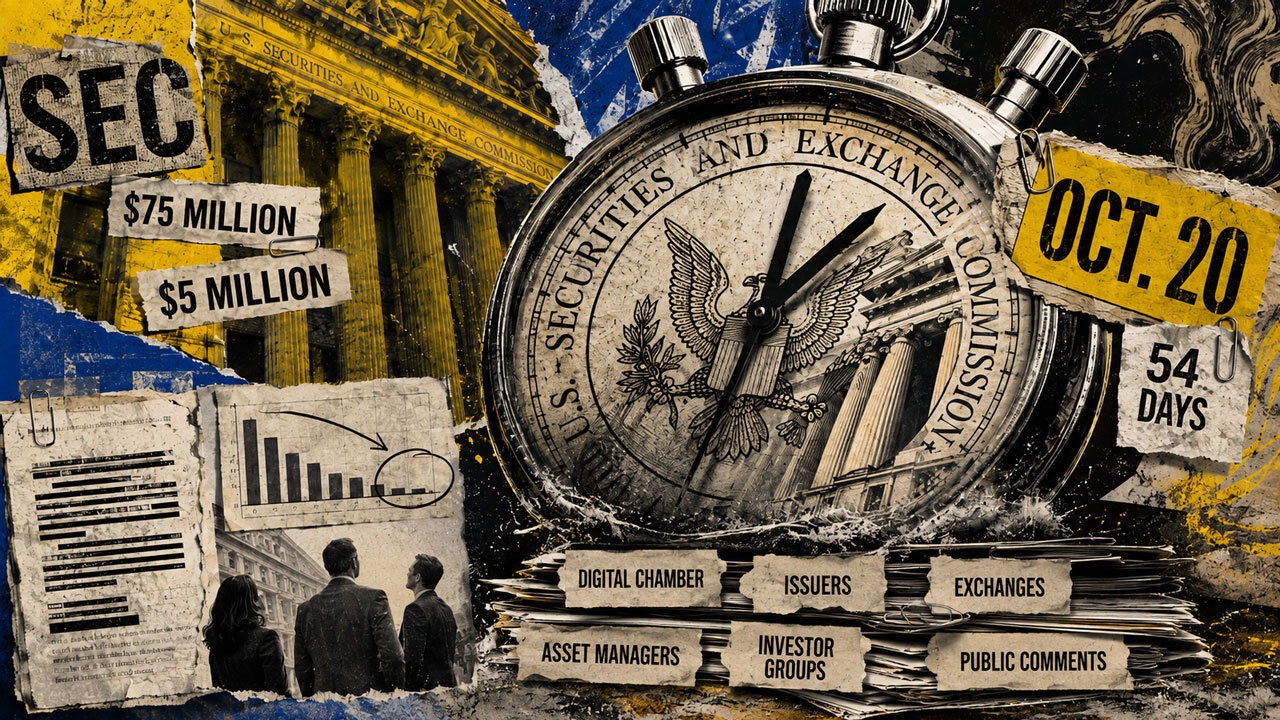
With the October 20 comment deadline approaching, institutional players have 54 days to influence one of the most consequential SEC crypto rulemaking proposals of 2026 — a dual-path fundraising exemption framework that could define how digital asset ventures access capital for years to come. So far, the formal comment record is conspicuously thin on major institutional presence, leaving the door open for asset managers, exchanges, and legal advocacy groups to meaningfully redirect the rule's final shape.
The SEC's proposed exemptions under Release No. S7-2026-27 would create two distinct fundraising paths for eligible crypto ventures: a lower-threshold route permitting raises of up to $5 million in any four-year period, and a higher-capacity route allowing up to $75 million within each 12-month period. The proposal has drawn 31 public comments as of August 27 — a modest tally given the stakes — with large institutions notably absent from the visible comment docket.
At its core, the SEC framework attempts to carve out a regulated on-ramp for crypto capital formation that operates outside traditional securities exemptions like Regulation A or Regulation Crowdfunding. By introducing token-specific disclosure forms and compliance pathways, the agency is signaling willingness to accommodate the asset class — but on its own terms.
The dual-path design reflects a deliberate calibration: the $5 million four-year track targets early-stage ventures where investor risk is highest and disclosure requirements are most critical, while the $75 million annual track is sized for growth-stage issuers who need larger capital pools but can absorb more regulatory overhead. For institutional compliance teams, the key question is whether the disclosure and intermediary requirements create workable due diligence frameworks — or new liability traps.
The letters filed so far map out the core fault lines that institutional commenters would do well to address before October 20.
The visible docket identifies no major crypto exchange, large asset manager, large token issuer, or established investor advocacy group in its comment rows — a gap that could allow smaller, narrower interests to disproportionately shape the final rule.
The Digital Chamber's presence in the docket is recorded as a meeting memorandum from an August 19 meeting, not a substantive comment letter. Its Token Alliance reportedly submitted 13 responses covering all 48 questions in an earlier request for information — but those materials sit in a pre-proposal archive outside the formal S7-2026-27 tally. That distinction matters: only comments filed directly into the S7-2026-27 docket carry weight in the rulemaking record that the SEC must formally address in its adopting release.
For BlackRock, Fidelity Digital Assets, Coinbase Institutional, and the major crypto law firms advising them, the October 20 deadline is not a soft target. The SEC's final rule will be shaped — and potentially constrained — by the record it has before it. Institutions that engage now can define the aggregation thresholds, disclosure standards, and intermediary safe harbors that govern the next generation of crypto capital markets. Those that wait will inherit whatever framework others negotiated.
The October 20 comment deadline is 54 days out. For compliance officers and institutional strategy teams tracking the regulatory landscape, this is the intervention point — not the adopting release. The time to shape the rule is now.
Keywords: SEC, crypto regulation, fundraising exemption, digital assets, institutional crypto
Source: CryptoSlate