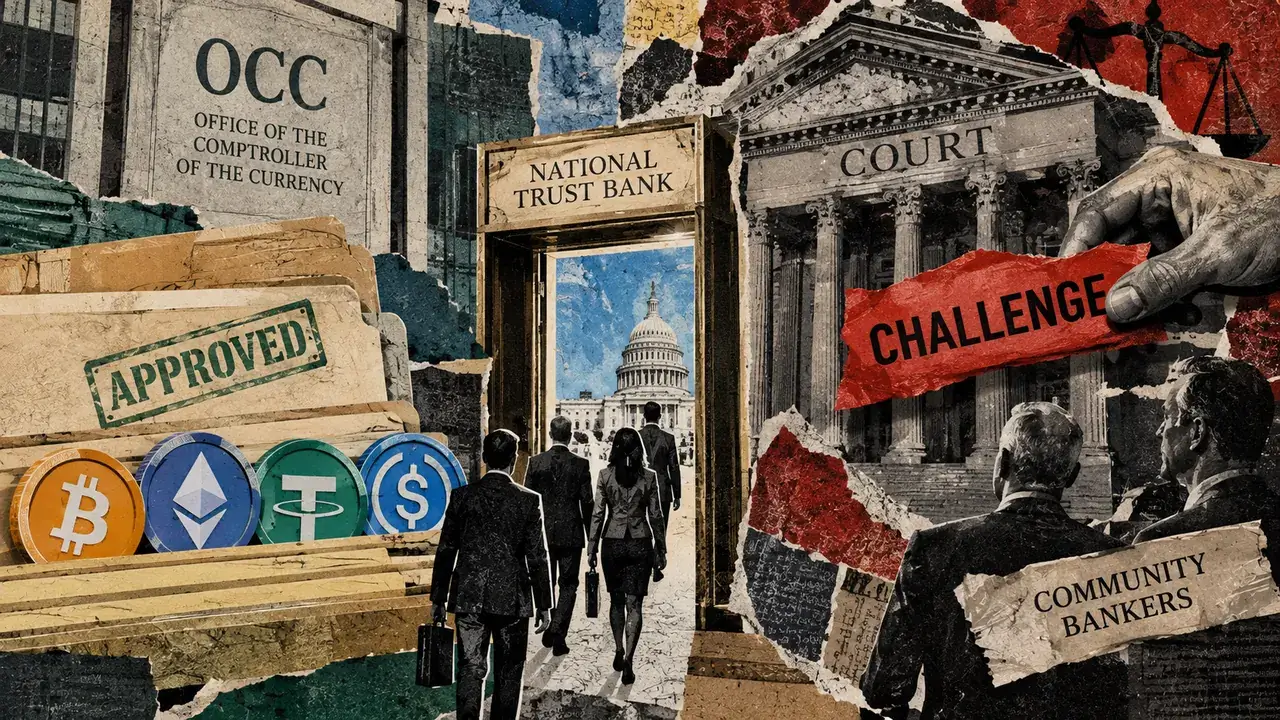
Community bankers launched a federal lawsuit on October 2, 2026, targeting the OCC's national trust bank charter program — the regulatory pathway now used by Coinbase, BitGo, Paxos, Ripple-linked entities, and at least 17 other crypto firms to operate under federal supervision. If the court sides with plaintiffs, stablecoin issuers and crypto custodians could be forced to restructure through state charters or affiliate arrangements, adding compliance cost and jurisdictional uncertainty across the industry.
What the ICBA Is Challenging
The Independent Community Bankers of America filed suit in federal court to invalidate the OCC's 2026 trust bank rule and Interpretive Letter 1176. The core argument: the OCC exceeded its statutory authority by allowing limited-purpose trust charters to cover nonfiduciary activities — including stablecoin issuance, payment processing, and digital asset custody — well beyond the traditional fiduciary scope Congress originally authorized.
The 2025–2026 rule replaced the older requirement that charters cover "fiduciary activities" with broader language: "the operations of a trust company and activities related thereto." That single phrase shift opened the door to 21 trust bank approvals, with 13 directly tied to crypto companies. The OCC, under Comptroller Jonathan Gould, has defended the language as consistent with longstanding chartering authority.
The Approval Timeline: How Quickly the Landscape Changed
The pace of approvals signals why community banks moved to court. In December 2025 alone, the OCC approved five applications — BitGo, Fidelity Digital Assets, First National Digital Currency Bank, Paxos, and a Ripple-affiliated entity. By February 2026, when the final rule took effect (April 1), Bridge, National Digital Trust, and Foris DAX received approvals. Coinbase followed in April, Laser Digital in May. Then on September 18 — just two weeks before the lawsuit — Agora, Catena, and Bastion cleared in a single batch.
In total, 40 de novo charter applications are on file at the OCC. Twenty-three involve digital assets. Community bankers see that pipeline as an existential competitive threat: federally chartered trust banks operate without FDIC deposit insurance obligations and with lighter capital requirements than full commercial banks.
Why the Stakes Are High for Compliance Officers
The stablecoin market is the pressure point. JPMorgan projects stablecoin supply could reach $500 billion by 2028. Coinbase's own model puts the figure at $1.2 trillion. Standard Chartered expects $2 trillion; Citi's base scenario for 2030 is $1.9 trillion, with an upside case near $4 trillion. Those numbers imply massive demand for regulated custody and issuance infrastructure — exactly the business the OCC trust charter enables.
"National trust banks have long performed some nonfiduciary work" — OCC response to the ICBA suit, defending the scope of Interpretive Letter 1176
For compliance teams at crypto firms currently operating under OCC trust charters, the lawsuit creates scenario-planning obligations now, not after a court ruling. If ICBA prevails, firms offering stablecoin issuance or payment services under a trust charter may need to either spin off those activities through state-regulated entities or restructure as full commercial banks — each carrying distinct capital, reporting, and examination burdens.
Regulatory Alternatives and Fallback Paths
- State trust charters: Many crypto firms hold state-level trust licenses (New York TDBA, Wyoming SPDI, South Dakota trust). A court ruling narrowing OCC authority would push more activity back to this fragmented state-by-state framework.
- Bank holding company structure: Firms wanting a unified federal footprint could acquire or charter a full commercial bank, but that triggers Fed oversight, full capital requirements, and FDIC premiums.
- Affiliate model: Regulated bank affiliates can hold custody while a separate entity handles nonfiduciary services — used by Fidelity and others — but compliance overhead rises sharply.
- Wait-and-see: The OCC has defended its position firmly; an appeal is likely regardless of first-instance outcome. Legal uncertainty could persist 18–36 months.
What to Watch
The court's threshold question is whether the 2026 OCC rule survives post-Chevron deference analysis — the Supreme Court's 2024 ruling eliminated agency deference, meaning courts now interpret ambiguous statutes independently. That shift raises the probability of a plaintiff-friendly outcome compared with prior regulatory challenges. Compliance teams should flag: any injunction against the rule could freeze pending approvals immediately and put issued charters into legal limbo. The 40-application pipeline, the $20.7 trillion FDIC-insured deposit system the ICBA is trying to protect, and the stablecoin Treasury demand expected to double to $400 billion by 2030 are all in play in this single case.
Keywords: OCC, trust bank charter, ICBA lawsuit, stablecoin regulation, crypto compliance, Coinbase, BitGo, Paxos, banking regulation