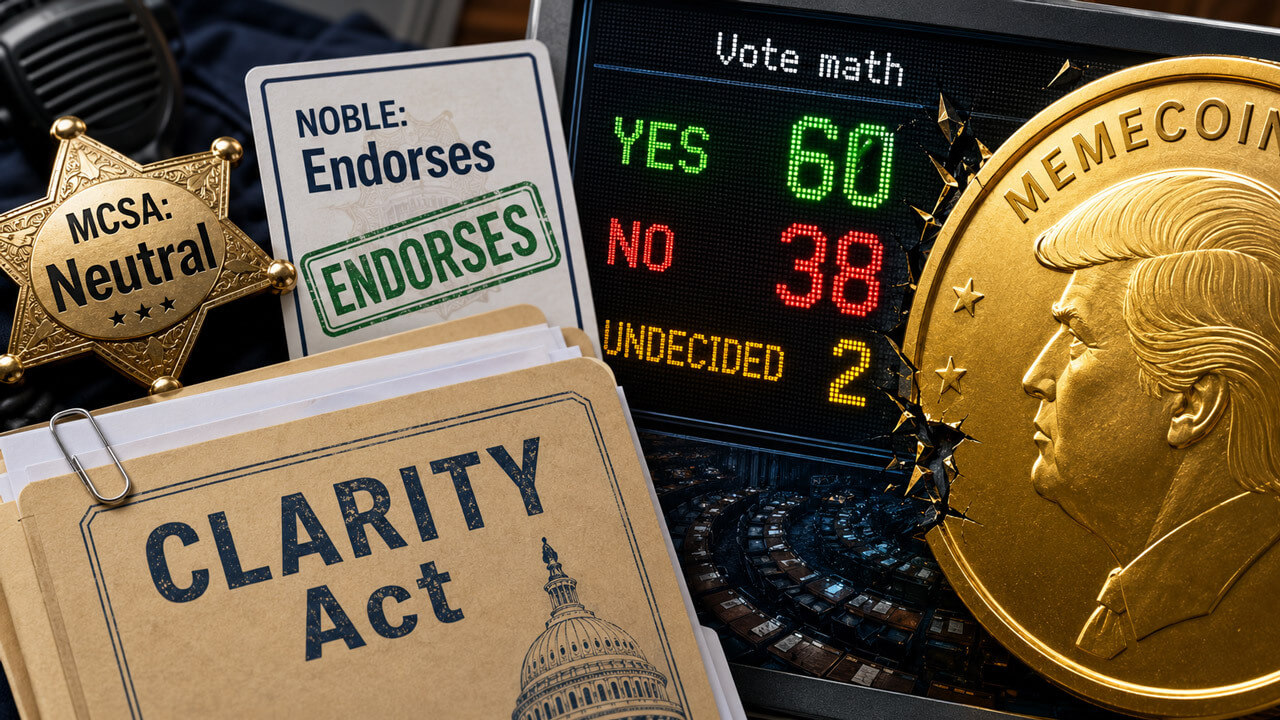
The CLARITY Act's odds of becoming law in 2026 improved slightly this week as a key law enforcement group shifted from opposition to neutral and a second endorsed the bill outright — but the Senate's real obstacle remains a political ethics standoff over Trump's memecoin profits, not technical crypto policy disputes.
For compliance professionals and institutional investors tracking U.S. crypto legislation, this week's developments are meaningful but not decisive. CLARITY still needs Democratic votes to clear a 60-vote filibuster threshold, and Democrats have made conflict-of-interest language a condition for their support — a condition that has grown more politically charged after President Trump's financial disclosures revealed hundreds of millions in 2025 income tied to his own memecoin.
The Major County Sheriffs of America (MCSA), which had previously opposed CLARITY in a May letter warning that Section 604 could create illicit finance loopholes, issued a new letter dated July 3 moving to neutral. The shift is conditional: MCSA wants a formal advisory role in Treasury's crypto-oversight bodies, along with federal funding for training, forensic technology, and investigations. These are narrow asks — easier for the Senate to accommodate than a full rewrite of Section 604's developer safe harbor provisions.
Simultaneously, NOBLE — the National Organization of Black Law Enforcement Executives — endorsed CLARITY outright, arguing the bill adds investigative tools rather than weakening them. NOBLE specifically cited the bill's 30-day transaction hold mechanism for covered agencies, Bank Secrecy Act provisions, and FinCEN funding as evidence that the legislation strengthens, not undermines, law enforcement capability.
"CLARITY would add meaningful new capabilities for investigators while preserving the criminal authorities police already rely on." — NOBLE statement, July 2026
For Senate Democrats who needed law enforcement cover to vote yes, this split gives them something to point to. The public-safety narrative on CLARITY is no longer one-sided.
Section 604 is the provision at the center of the law enforcement debate. It establishes a safe harbor for non-controlling developers and infrastructure providers — entities that write software or enable self-custody without taking custody of user funds. These actors would not be classified as money transmitters for those activities alone.
Critics argued the carve-out was too broad, potentially shielding mixers, tumblers, and some DeFi protocols from money-transmission oversight. With MCSA's shift toward a narrower demand — consultation rights and resources rather than eliminating Section 604 — the legislative trade now looks more achievable: accept the safe harbor, add advisory roles and forensic funding, move on.
Senator Kirsten Gillibrand renewed her push on July 3 to bar elected officials and their spouses from issuing or endorsing digital assets. Her renewed push is directly tied to Trump's financial disclosures, which showed the president earned hundreds of millions from a memecoin he personally issued — a disclosure that turns any CLARITY floor vote into a referendum on whether Congress should regulate crypto while the president profits from it.
Democrats broadly support ethics language as a floor condition, and the Trump disclosure has hardened that position. Republicans face the inverse pressure: any ethics amendment can be framed as an attack on the president, making it politically costly to accept even narrow conflict-of-interest provisions.
CLARITY's Section 604 safe harbor is the provision most relevant to institutional participants building on-chain infrastructure. A stable legal definition of non-controlling developer liability would reduce compliance ambiguity for custodians, protocol developers, and firms building permissioned DeFi products. The MCSA shift suggests that safe harbor definition is closer to surviving intact than it appeared two months ago.
For ETF issuers and asset managers, the more important signal is floor timing. CLARITY still requires Senate passage, a House reconciliation process, and a presidential signature before the election-year clock closes. Even a positive policy trajectory cannot compensate for a calendar that is running out. Teams modeling regulatory timelines should weight the August recess as a hard constraint — if CLARITY does not reach a floor vote before it, the probability of 2026 enactment drops substantially, even if the policy gaps narrow further.
The bottom line: this week's law enforcement developments make a CLARITY floor vote more plausible, but the ethics fight over who profits from crypto while writing its rules remains the variable that determines whether that vote actually happens.
Keywords: CLARITY Act, crypto regulation, SEC legislation, Senate crypto bill, digital asset compliance, stablecoin law, DeFi regulation, crypto ethics, Trump memecoin, institutional crypto
Source: CryptoSlate