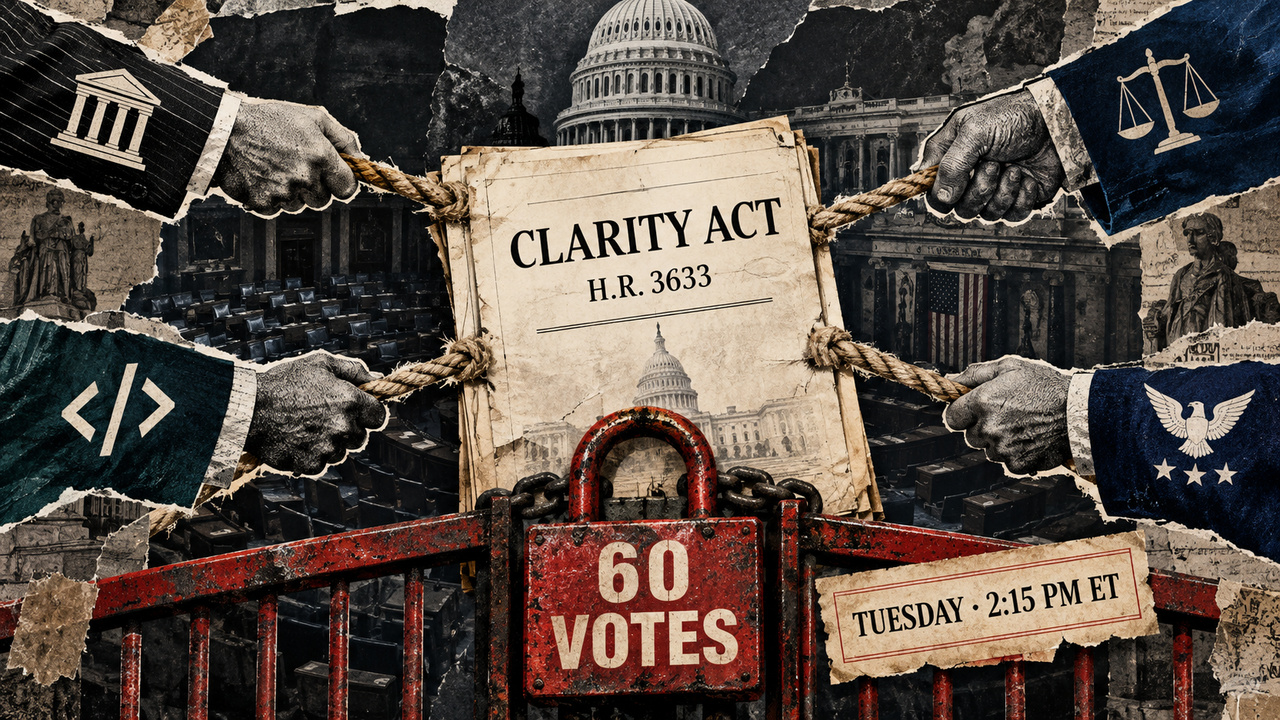
The U.S. Senate is scheduled to hold a cloture vote on H.R. 3633 — the CLARITY Act — on September 15, 2026, despite the bill's sponsors acknowledging that key provisions remain unresolved. For institutional compliance teams, the procedural posture matters as much as the legislative text: a successful 60-vote threshold to proceed would lock in the amendment process as the primary venue for resolving contested issues around DeFi exemptions, stablecoin yields, and CFTC jurisdiction — an outcome with direct implications for how digital asset desks structure compliance frameworks heading into Q4.
The vote is not a final passage vote. It is a motion to proceed — the Senate's mechanism for formally opening floor debate and enabling amendments. Republicans currently hold 53 seats, meaning the majority whip needs at least seven Democratic crossovers to clear the procedural hurdle. That math has not yet been secured, and at least two Republican senators, Thom Tillis and Mike Rounds, have signaled reservations, adding further uncertainty to what the White House is framing as a "get on the bill and keep talking" moment.
Hours before the scheduled vote window opened, Republicans released revised legislative text (EHF26718) introducing the most substantive regulatory architecture update seen in the CLARITY Act's current form: a CFTC framework for identifying "controlled protocols." The provision targets blockchain networks that claim decentralization status while retaining functional control over protocol parameters or upgrade paths. Under the proposed Section 20209, such protocols would not qualify for the DeFi exemptions embedded elsewhere in the bill.
This addition was clearly designed to address Democratic holdouts who had flagged the original DeFi carve-outs as overly permissive. From a compliance standpoint, the "controlled protocol" definition is the provision that institutional legal teams should examine most carefully: how the CFTC operationalizes the distinction between genuine decentralization and nominal decentralization will determine whether a wide range of DeFi-adjacent products — structured yield products, on-chain derivatives, tokenized fund wrappers — fall inside or outside CFTC primary jurisdiction.
If cloture is invoked and debate proceeds, the amendment process becomes the live regulatory drafting environment. Compliance officers should track four contested areas that remain unresolved in the current text:
A failure to reach 60 votes would not kill the CLARITY Act — but it would reset the negotiating timeline significantly. The most likely outcome in that scenario is a return to committee-level negotiations, potentially with a narrower bill that separates the stablecoin title from the market structure framework. Institutions that have been calibrating their digital asset compliance infrastructure around a unified CLARITY Act framework should maintain scenario planning for a bifurcated legislative outcome, as stablecoin and spot market rules could advance on separate tracks with separate effective dates.
"Get on the bill and let's keep talking" — the White House adviser framing that characterized the Republican strategy of advancing to floor debate before all disputes are resolved, betting that the amendment process itself becomes the negotiation venue.
For asset managers, broker-dealers, and custodians with existing or planned digital asset programs, the September 15 vote is a directional signal rather than a compliance trigger. No provisions take immediate effect upon a cloture vote. However, the vote outcome will clarify the realistic timeline for CFTC spot market oversight — the structural change that most directly affects how institutional-grade crypto products are registered, marketed, and reported. Firms that have been deferring compliance buildout pending legislative certainty should treat a successful cloture vote as the signal to accelerate internal readiness work, particularly around CFTC registration pathways and the controlled-protocol definition's implications for any DeFi-linked structured products in their pipeline.
The CLARITY Act, if enacted in something close to its current form, would represent the most significant reallocation of digital asset regulatory jurisdiction since the SEC began asserting securities-law authority over token offerings in 2017. The September 15 procedural vote will not settle that question — but it will determine whether 2026 remains the year that question gets answered.
Keywords: CLARITY Act, Senate cloture vote, crypto regulation, CFTC, digital assets legislation, DeFi, stablecoin, controlled protocols
Source: CryptoSlate