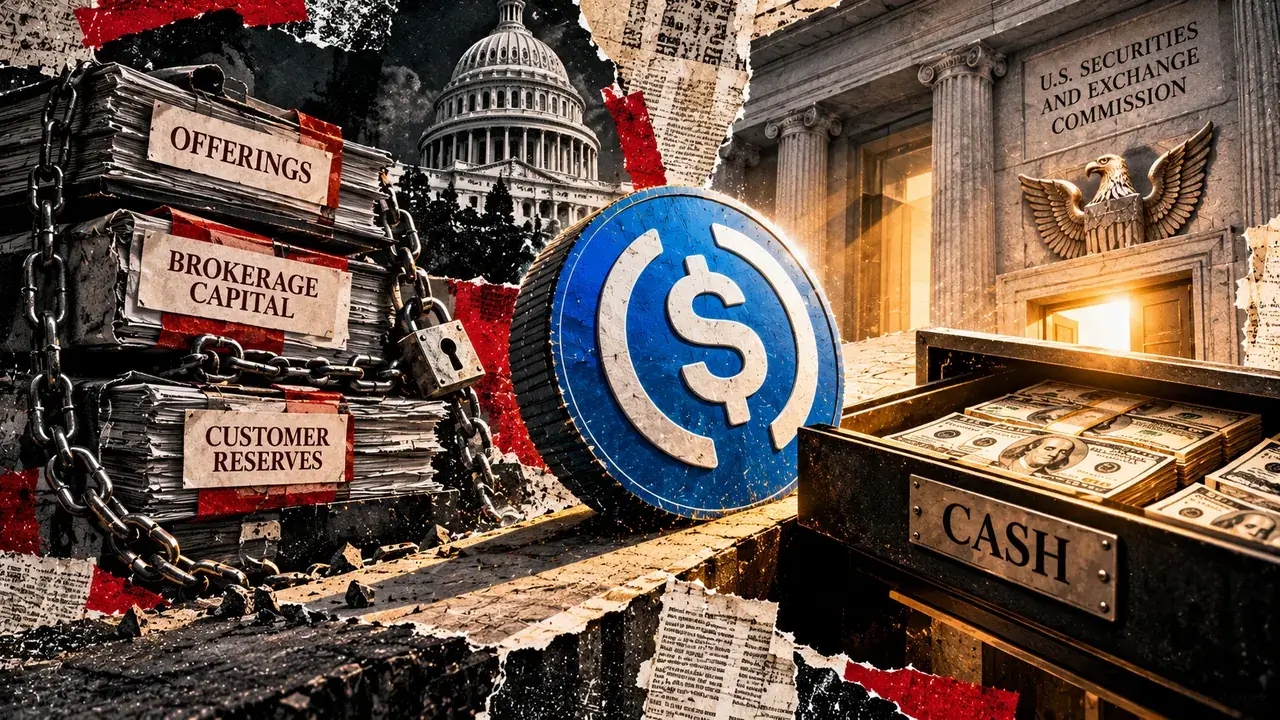
Circle, the issuer of USDC, is asking the SEC to stop treating regulated payment stablecoins as a special category and start treating them like cash across securities markets. In an October 28 statement that builds on an October 20 letter, the company targets three areas: capital raising under the Commission's proposed Regulation Crypto Assets, broker-dealer net capital, and customer reserve accounts. The most consequential request is the capital haircut, because it determines how much balance-sheet room securities firms can devote to dollar tokens. None of the requests has been approved.
The SEC's proposed Regulation Crypto Assets would create a framework for companies raising money through certain crypto offerings, including two registration exemptions: up to $5 million over four years, and up to $75 million per year subject to disclosure and other conditions. The draft already allows permitted stablecoins to count toward the amount raised.
Circle supports the framework but wants confirmation that payment stablecoins issued under the GENIUS Act count as cash when investors use them to participate. Without that, it argues, an issuer could face different procedures depending on whether a subscriber pays by bank transfer or with dollar tokens. Circle also wants one-for-one redeemable stablecoins valued at face value, so on-chain payments do not trigger extra valuation work, and it argues that accepting stablecoins as payment should not automatically pull the tokens or their issuers into the securities obligations attached to what is being sold.
Net capital measures how much capacity a broker-dealer has to support trading and absorb losses. Under February SEC staff guidance, firms may apply a 2% haircut to qualifying stablecoin positions held for their own account. That reduces the value recognized for regulatory purposes: a $1 billion qualifying position would shave $20 million from calculated net capital.
Circle wants that haircut eliminated for payment stablecoins that satisfy GENIUS Act standards, arguing that the statute's reserve, redemption, liquidity and consumer-protection requirements justify better treatment than other digital assets receive. One caveat matters for modeling: the 2% figure comes from nonbinding staff guidance rather than a Commission rule, so a zero haircut would need broader regulatory acceptance. The real benefit would also scale with how much stablecoin inventory brokers actually hold.
The third request concerns Rule 15c3-3, which requires broker-dealers to keep qualifying assets in reserve accounts to protect customer funds. Those rules currently contemplate cash and certain securities. Circle wants the SEC to clarify whether compliant payment stablecoins can count toward the requirement, which could let firms hold part of their reserves in digital dollars. That would demand separate regulatory action and added safeguards.
Issuer-level safeguards under the GENIUS Act do not automatically settle how a stablecoin is treated under every securities rule.
Circle has an obvious commercial interest, and readers should weigh the proposal accordingly. Yet the argument rests on a coherent premise: if a regime already regulates reserves and redemption, securities rules that apply punitive treatment to the same instrument duplicate costs without adding protection. The counterargument is equally clear. Banking-style safeguards do not map neatly onto broker-dealer risk, and staff-level relief can be reversed more easily than rule text.
For institutional investors, the near-term takeaway is directional rather than immediate. A cash-equivalent designation for compliant stablecoins would lower the cost of using them for settlement, margin and client funding at securities firms, strengthening the case for USDC-style instruments in regulated workflows. Watch for any Commission response to the comment letter, whether staff guidance gets codified into rules, and how closely agencies align their definitions ahead of the January 2027 effective date.
Keywords: Circle, USDC, GENIUS Act, stablecoin regulation, broker-dealer net capital, Rule 15c3-3, Regulation Crypto Assets, SEC
Source: CryptoSlate