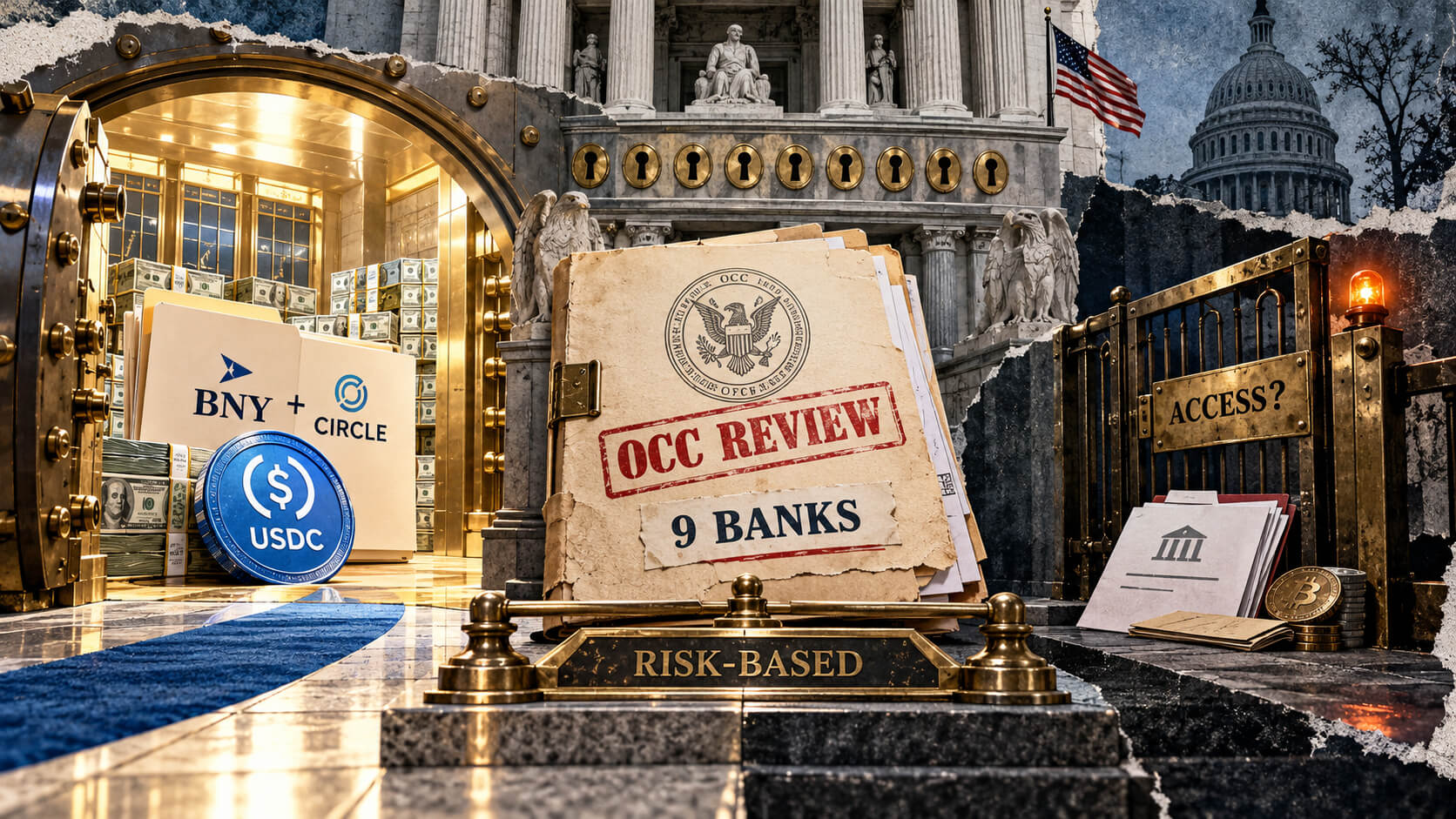
The Office of the Comptroller of the Currency has found that nine of the largest U.S. national banks systematically denied banking services to crypto businesses — and it is now deploying binding supervisory rules to stop the practice. Released on October 14, 2026, the OCC review covers policies at JPMorgan Chase, Bank of America, Citibank, Wells Fargo, US Bank, Capital One, PNC Bank, TD Bank, and BMO Bank, spanning from 2020 through September 2025. The takeaway for U.S. crypto investors and businesses: debanking as an industry-wide policy is under direct regulatory fire, but the path to actually opening a crypto company bank account remains uneven.
The review was sweeping in scope. OCC examiners analyzed nearly 100,000 complaints and 420,000 pages of internal documents from the nine banks. The pattern that emerged was consistent: digital-asset issuers, exchanges, and administrators were frequently denied accounts or had existing accounts closed — not based on individualized financial crime assessments, but on broad categorical exclusions tied to the crypto industry label itself.
Comptroller Jonathan Gould framed the core problem plainly: banks were using reputational risk as a backdoor justification to avoid entire customer categories without conducting the objective, case-by-case due diligence that federal banking standards actually require. In practice, this meant legitimate, compliant crypto businesses faced the same account denials as genuinely high-risk actors — a blunt instrument with real consequences for the industry's ability to operate within the regulated financial system.
The OCC is not eliminating bank discretion — it is redefining the permissible basis for exercising it. Under the new supervisory framework, banks retain the authority to decline or exit customer relationships, but only when grounded in objective, documented financial, operational, or compliance considerations specific to that customer. What is now explicitly prohibited is using reputation risk as pretext for blanket industry exclusions.
One day before the OCC released its debanking findings, Bank of America received a $750 million civil penalty for deficiencies in transaction monitoring, reporting, compliance expertise, and staff training. The timing is not coincidental. It illustrates the dual pressure banks now face: enforcement risk for inadequate AML programs on one side, and OCC supervisory scrutiny for using AML concerns as a blanket pretext to exclude crypto clients on the other. Banks that blanket-deny crypto accounts to minimize compliance exposure may find that the regulatory calculus has shifted against them.
On June 29, 2026, BNY Mellon announced institutional stablecoin services through Circle, allowing clients to hold USDC in custody and execute mint and redemption transactions. The partnership is a meaningful signal that the largest custodial institutions are moving toward crypto integration at the institutional tier — but it is precisely that: the institutional tier. Smaller crypto firms — startups, independent exchanges, token issuers — remain in a different category where the practical impact of the OCC's new framework has yet to be tested at scale.
"Banks should evaluate customers using objective, risk-based criteria — not blanket exclusions based on industry category or reputational concerns." — Comptroller Jonathan Gould, OCC, October 2026
For individual U.S. crypto investors, the direct impact is limited — retail accounts at major banks are not the primary target of the debanking documented in the OCC review. The sharper implications land on anyone building or operating within the crypto ecosystem: exchanges seeking fiat on-ramps, stablecoin issuers needing reserve custodians, and asset managers bridging digital and traditional markets. If the OCC's supervisory framework takes hold operationally — not just on paper — these businesses should gain clearer grounds to challenge categorical denials and demand documented, individualized justifications from any bank that declines their account applications.
The broader significance is structural. The OCC review marks the first time a federal banking regulator has formally documented the debanking pattern at this scale and responded with binding supervisory guidance aimed at reversing it. Whether it translates into meaningful access for the long tail of crypto businesses depends on how consistently examiners enforce the new standards — and whether banks internalize the message that blanket exclusions now carry their own regulatory exposure.
Keywords: OCC debanking rule, crypto bank access, Office of the Comptroller of the Currency, crypto debanking, Jonathan Gould OCC, Bank Secrecy Act crypto, crypto compliance banking, digital asset banking policy
Source: CryptoSlate